The authenticity layer of a more resilient internet

Filecoin is the world's largest decentralized storage network. By leveraging cryptographic verification and global redundancy, Filecoin safeguards humanity's information, keeping it free from centralized control.

Solar eclipse with the sun forming a bright diamond ring behind the moon.

What is Filecoin?

A decentralized alternative to today's storage solutions.

Filecoin is a decentralized alternative to today's storage solutions, offering a better foundation for humanity's information.

A handful of corporations currently control most of the world's data. This centralized model creates gatekeepers, introduces single points of failure, and reduces transparency.

Filecoin offers a fundamentally different approach to data storage by distributing data across a decentralized, global network, protected by cryptographic proofs.

Loading Video...

What is Filecoin used for?

From archival backups to Web3 and AI apps, Filecoin offers decentralized, secure, and verifiable storage at scale.

  • Close-up view of a computer motherboard showing chips and circuits

    Web3 apps & AI datasets

    Powering the data layer for NFTs, video streaming, AI training datasets, and dApps.

  • Rows of shelves filled with old books in an archive room

    Backups & archival storage

    Secure, long-term storage for mission-critical data.

  • Marble busts lined up beside tall bookshelves in a historic library

    Cultural archives

    Preserving humanity's knowledge and records for the long term.

  • Laboratory pipette dispensing pink liquid into test tubes

    Scientific datasets

    Enabling resilient access to genomics, public research, and large-scale scientific data.

How data moves through Filecoin

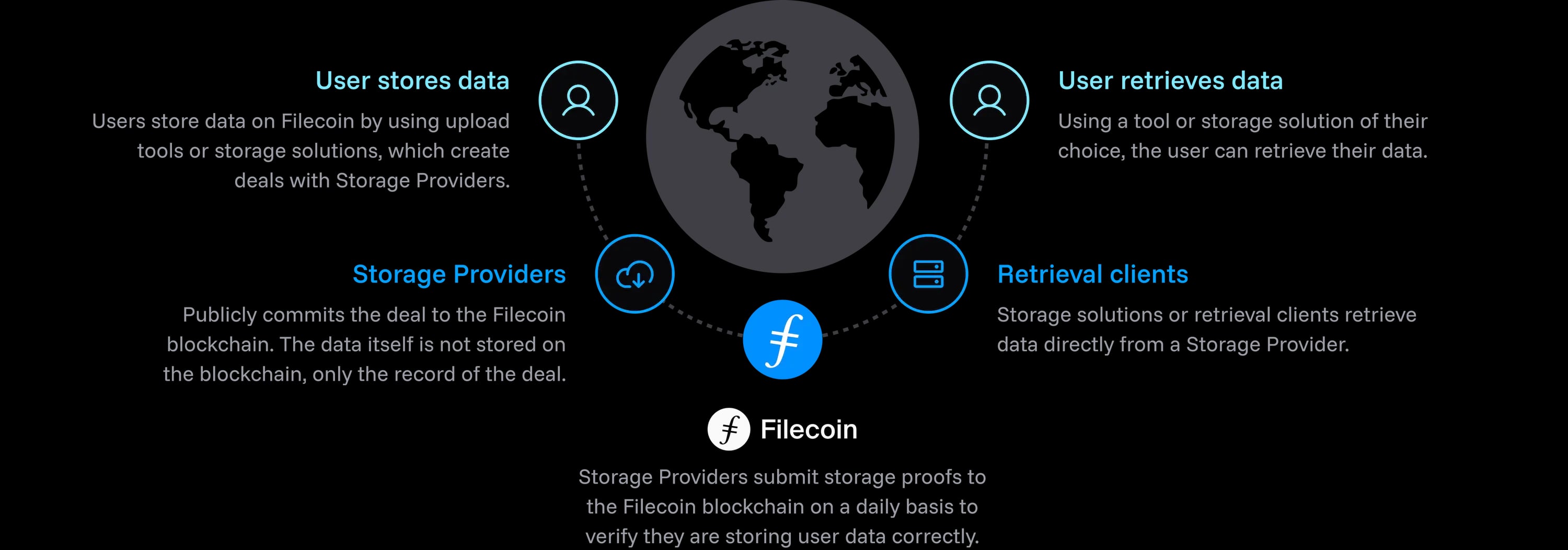
Users and storage providers interact through onchain deals. The blockchain records and monitors these deals, using publicly verifiable proofs to ensure the data is correctly stored and accessible.

Diagram showing how data moves through the Filecoin network. A circular flow surrounds a globe representing the global network. On the left, a user icon labeled “User stores data” explains that users upload data to Filecoin using storage tools or services, which create storage deals with Storage Providers. Below, Storage Providers are shown committing these deals to the Filecoin blockchain; the diagram notes that the blockchain stores only the record of the deal, not the data itself. At the bottom, the Filecoin logo represents the blockchain, where Storage Providers regularly submit cryptographic storage proofs to verify they are correctly storing user data. On the right, a section labeled “Retrieval clients” explains that storage solutions or retrieval clients fetch data directly from Storage Providers. At the top right, another user icon labeled “User retrieves data” indicates that users can retrieve their stored data using a tool or storage solution of their choice. The overall graphic illustrates a decentralized, global data storage and retrieval process coordinated through Filecoin.

Decentralized by design

The Filecoin network provides decentralized storage secured by cryptographic proofs and economic incentives, transforming data storage into open, verifiable infrastructure.

  • Onchain proof of storage

    Filecoin uses two proofs to ensure data integrity: Proof of Replication verifies a unique copy of data exists, and Proof of Spacetime confirms it remains stored over time.

  • Powered by incentives

    The Filecoin token (FIL) powers the network's economy. Clients pay in FIL to store data, while providers earn FIL by offering reliable services. Providers must lock FIL as collateral and earn rewards by submitting valid proofs.

  • Verifiable retrieval

    With Filecoin Onchain Cloud, retrieval performance is provable onchain, turning speed and reliability into measurable, verifiable metrics.

  • Built for scale

    The network's infrastructure is designed to support exabyte-scale datasets and long-term preservation with built-in global distribution and redundancy.

Learn about the Filecoin protocol

For technically curious people who want to go deeper into how Filecoin actually works.

  • Content addressing

    Files are retrieved via content identifiers (CIDs) instead of location-based URLs prone to deterioration.

    See how content addressing works
  • Storage & retrieval deals

    Clients make programmable deals with independent storage providers in a global marketplace.

    Learn about storage deals
  • Proofs & verification

    Providers must cryptographically prove they are storing data.

    Understand Filecoin proofs
  • Token Incentives (FIL)

    The native token aligns economic incentives and rewards useful storage over time.

    Explore FIL token economics
  • Filecoin Virtual Machine (FVM)

    The smart-contract layer that lets developers build logic, automation, and apps on top of Filecoin storage.

    Discover the FVM
  • Filecoin Plus (Fil+)

    An incentive system that aims to increase the amount of useful data stored on the Filecoin network.

    Read about Filecoin Plus

Be a part of a more resilient internet

Filecoin is more than storage; it's an innovative, open ecosystem built to preserve humanity's information.

  • Build on Filecoin

  • Store your data

  • Become a storage provider

  • Join the community